SICP Chapter 3.2
Section 3.2
Notes
Definition of a frame. A frame is a table (dictionary) of bindings which associate variable names to their values, along with a pointer to its enclosing environment. A single frame may contain at most one binding for any variable.
An environment is a sequence of frames.
Each frame is a table of bindings.
Each binding associates variable names with their corresponding values.
define creates definitions by adding bindings to frames.
Note from chat: How do we write recursive lambdas anyways? rcr points out
auto factorial = []() { ... factorial(...); ... } fails in C++.
Meeting 05-18-2025
Environment and frame distinction: This is a bit confusing, but the definition in the book can be taken at face value:
An environment is a sequence of frames. Each frame is a table (possibly empty) of bindings, which associate variable names with their corresponding values. (A single frame may contain at most one binding for any variable.) Each frame also has a pointer to its enclosing environment, unless, for the purposes of discussion, the frame is considered to be global.
At first I thought that "each frame also has a pointer to the next frame in the sequence of frames" would be a better definition, and I still think of each frame as storing a pointer to a frame rather than a pointer to an environment (this matches the diagrams better anyways, where frames point to other frames), but I suppose that the pointer-to-frame can be considered to be an "environment".
Some notes from our conversation:
-
Because it's so easy to confuse terms, it's probably best to watch the video chapters corresponding to this course! Ie the 1986 MIT lectures or Spring 2010 Berkeley.
-
All function calls will create frames, but special forms don't! So,
ifdoesn't, for example. Gerry calls this out in his 1986 lecture. - We had a discussion about how to create deeply nested frames (or "deeply chained" frames). The way to do this isn't to call a procedure a bunch, but instead to declare lambdas-within-lambdas-within-lambdas. Calling a procedure a bunch will just create many frames which refer to the frame in which the procedure was defined, not a deep nesting.
- Lexical scope vs dynamic scope. It was mentioned that Mathematica is
dynamically scoped, with tools for lexical
scoping using
Block[]andModule[]I've never thought about this from a deep systems / language POV before. An analogy I drew but I should be cautious of: dynamic scoping might be more like referencing a javascript objectvar global;to dynamically add and remove symbols from it. This issue of whether a symbol is defined is a matter of whether global[symbol] is undefined at a given time. - Note that my first instinct on drawing the fibonacci procedure was wrong, I drew deeply nested environments but in fact it's 6 different environments and the tree is shallow and wide not narrow and deep.
More stuff on Lisp compilers:
- https://en.wikipedia.org/wiki/Self-hosting_(compilers)
- https://www.paulgraham.com/lisphistory.html ("at least read history of T") (adjacent: https://www.paulgraham.com/hp.html )
- https://www.sbcl.org/porting.html
- https://texdraft.github.io/
- https://norvig.com/lispy.html
- https://gchandbook.org/
Exercises
Exercise 3.9
In 1.2.1 we used the substitution model to analyze two procedures for computing factorials, a recursive version
(define (factorial n)
  (if (= n 1)
      1
      (* n (factorial (- n 1)))))
and an iterative version
(define (factorial n)
  (fact-iter 1 1 n))

(define (fact-iter product
                   counter
                   max-count)
  (if (> counter max-count)
      product
      (fact-iter (* counter product)
                 (+ counter 1)
                 max-count)))
Show the environment structures created by evaluating (factorial 6)
using each version of the factorial procedure.
Solution
factorial E1: n:6
factorial E2: n:5
factorial E3: n:4
factorial E4: n:3
factorial E5: n:2
factorial E6: n:1
factorial E1: n:6
fact-iter E2: product: 1, counter: 1, n: 6
fact-iter E3: product: 1, counter: 2, n: 6
fact-iter E4: product: 2, counter: 3, n: 6
fact-iter E5: product: 6, counter: 4, n: 6
fact-iter E6: product: 24 counter: 5, n: 6
fact-iter E7: product: 120 counter: 6, n: 6
fact-iter E8: product: 720 counter: 7, n: 6
Exercise 3.10
In the make-withdraw
procedure, the local variable balance is created as a parameter of
make-withdraw. We could also create the local state variable
explicitly, using let, as follows:
(define (make-withdraw initial-amount)
  (let ((balance initial-amount))
    (lambda (amount)
      (if (>= balance amount)
          (begin (set! balance
                       (- balance amount))
                 balance)
          "Insufficient funds"))))
Recall from 1.3.2 that let is simply syntactic sugar for a
procedure call:
(let ((⟨var⟩ ⟨exp⟩)) ⟨body⟩)
is interpreted as an alternate syntax for
((lambda (⟨var⟩) ⟨body⟩) ⟨exp⟩)
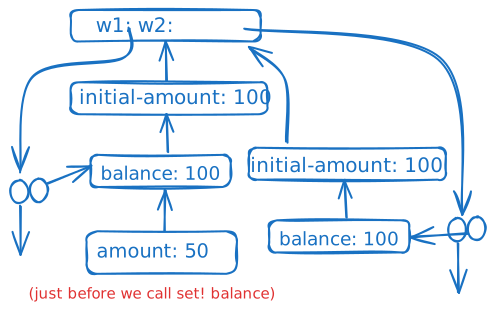
Use the environment model to analyze this alternate version of
make-withdraw, drawing figures like the ones above to illustrate the
interactions
(define W1 (make-withdraw 100))
(W1 50)
(define W2 (make-withdraw 100))
Show that the two versions of make-withdraw create objects with the same
behavior. How do the environment structures differ for the two versions?
Solution
Exercise 3.11
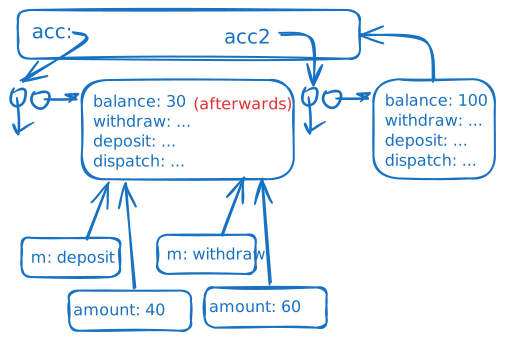
In 3.2.3 we saw how the environment model described the behavior of procedures with local state. Now we have seen how internal definitions work. A typical message-passing procedure contains both of these aspects. Consider the bank account procedure of 3.1.1:
(define (make-account balance)
  (define (withdraw amount)
    (if (>= balance amount)
        (begin (set! balance
                     (- balance
                        amount))
               balance)
        "Insufficient funds"))
  (define (deposit amount)
    (set! balance (+ balance amount))
    balance)
  (define (dispatch m)
    (cond ((eq? m 'withdraw) withdraw)
          ((eq? m 'deposit) deposit)
          (else (error "Unknown request:
                        MAKE-ACCOUNT"
                       m))))
  dispatch)
Show the environment structure generated by the sequence of interactions
(define acc (make-account 50))

((acc 'deposit) 40)
90

((acc 'withdraw) 60)
30
Where is the local state for acc kept? Suppose we define another
account
(define acc2 (make-account 100))
How are the local states for the two accounts kept distinct? Which parts of
the environment structure are shared between acc and acc2?
Solution